
2016 Apr 1
by WIMARSHANA
ANYBODY WITH EVEN A MODICUM OF EXPOSURE ACCEPTS THAT THE STANDARD OF LIVING AND THE opportunities to succeed in countries such as Australia, Japan and Singapore are far greater than they are in Sri-Lanka. And it’s not just the vastly superior material well-being and job prospects. From sewage disposal to maniacal drivers, from political brats to the justice system, and from the petty jealousy to the typical moronism of the average Sri-Lankan—in all these regards, things are better in the developed world (thus, obviously, the label ‘developed’). Now, granted, there is more to life than order, fairness and material well-being, yet these are the indispensable foundation stones necessary to begin building what philosophers often refer to as the ‘good life’.
So the question then is—why? There are four common scapegoats: colonialism, the civil war, education and politicians. All of them are the wrong answer. All of them are, in complicated sociological ways, the horrendous symptoms of the underlying disease, not the disease itself. So what is the real problem, the underlying disease? In one of my previous books—Colombo: A Critical Introspection—I explored the sociological and philosophical roots, the WHYs and HOWs, of this problem. It’s difficult to sum up a large work like Colombo in just one word, but if I were to do so anyway: in one word the problem is culture. And this is the single greatest irony of the Sri-Lankan experience. For along with the four aforementioned scapegoats, the abandonment of our once glorious culture is touted as both a primary cause of our misery and a return to it as the solution. But let me be clear: our 2500 year old culture that we so revere is not the solution to our problem, it is the problem! Why you may ask? Again to crudely sum up Colombo, our culture creates bad citizens; more precisely disastrously maladjusted citizens. Citizens who are fashioned to function optimally only in the historical time and place—the historical context—where our culture emerged. A useful way to think about this is to consider citizens as apps and social systems (roads, schools, free markets, courts etc.) as hardware. Imagine running apps written for your old 1980s IBM 386 or your Apple II (if anybody remembers these classic computers) on your iPad Air. At the very least, these apps will not be able to utilize the full potential of your state-of-the-art technology. At worst, they will not work at all and perhaps they will make your space-age gizmos crash. If this is all a little ‘out there’, here is a concrete example. Have you seen Sri-Lankans drive? They have no concept of a lane, right-of-way, when to honk the horn or indeed anything to do with proper driving except the smallest part of driving: making the vehicle move. The typical Sri-Lankan was created thousands of years ago, long before the advent of modern social systems. Modern roads, motor vehicles and road rules taken together are one such modern social system. In other words, when an outdated app (the Sri-Lankan citizen) attempts to function utilizing a new hardware platform (the traffic system), the result can and must be, at the very most, sub-optimal. There is absolutely no way that the best outcomes of modern systems can be realized. This sub-optimization when totaled up across all social systems results in the widespread chaos, deprivation and misery that has come to be accepted as everyday life in Sri-Lanka. In fact, it is useful to get rid of the term the ‘bad citizenship’ altogether and start off with the premise that there is no citizenship in Sri-Lanka whatsoever. Waving your flag at cricket matches and thumping your chest at all sorts of perceived slights does not count.
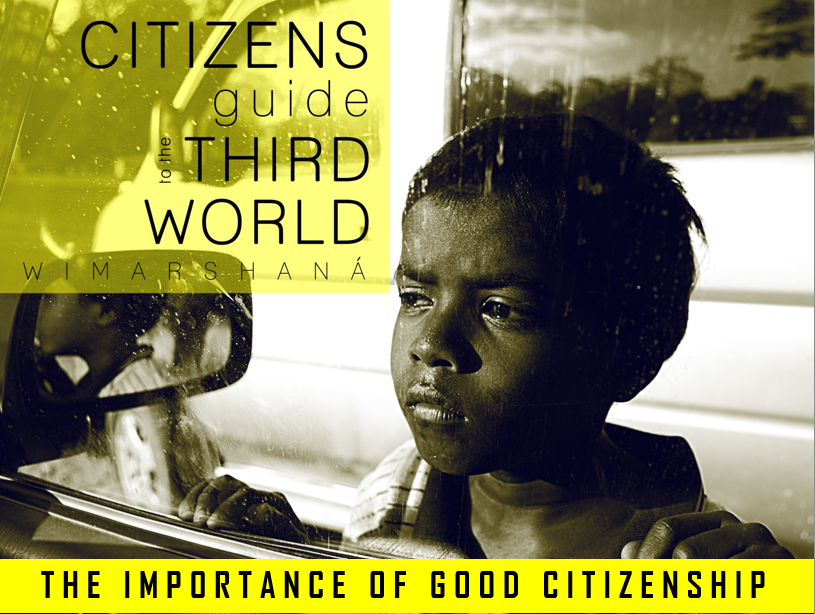
The CGTW is a book of action. It provides an extensive (though not complete) book of simple and practical rules which if each citizen of this country and the rest of the Third World practice in their daily lives—soon, the chaos will become harmony, corruption will become integrity, injustice will become fairness, war will become peace, and poverty will become prosperity.What must be done about this? Well, the old Sri-Lankan must be gradually erased and reprogrammed into a new modern, global citizen. This is not only the single greatest challenge facing Sri-Lanka but also the single greatest challenge facing the entire Third World. Of course we must start somewhere, and this is why I wrote the Citizens’ Guide to the Third World (or CGTW). The CGTW is a self-help book, a reprogramming guide, for culture.
THE CGTW IS ENTIRELY
|